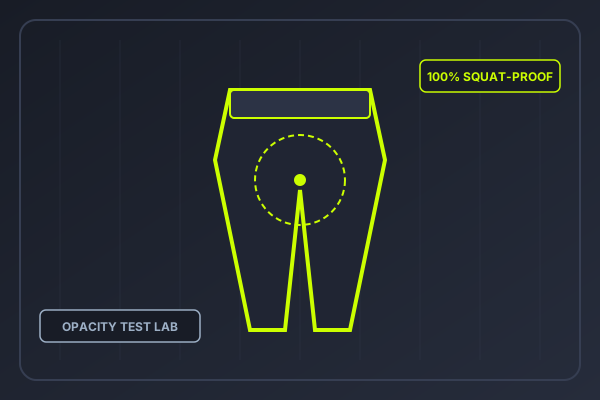
Looking for verified, 100% squat-proof seamless gym tights?
Tested under full knee-flexion loads with reinforced high-waist support.Every lifter who has ever stepped into a commercial gym knows the feeling of checking their reflection in the mirror at the bottom of a deep Romanian deadlift or back squat. The term squat proof leggings has become a staple buzzword in activewear marketing, yet many pairs ordered online fail the moment fabric stretches over high-tension muscle curves.
When evaluating gym wear for women, understanding textile density and elongation mechanics prevents buyers from wasting money on thin fast-fashion tights that degrade after three laundry cycles.
1. What Actually Makes Leggings "Squat-Proof"?
True squat-proof performance is not magic; it is an engineered balance of yarn thickness, knit construction, and tension recovery. When you sink into a parallel squat, the fabric around your glutes and hamstrings experiences biaxial strain of up to 45% to 65% stretch, a threshold evaluated under standard ASTM D4964 tension and elongation protocols.
- Interlock Circular Knits vs Single Jersey: Cheap leggings utilize single-knit jersey fabric. While soft, jersey separates quickly under tension, revealing underwear or skin. Performance leggings use high-gauge double-knit interlock or seamless circular weaves where two sets of needles loop yarns together, forming a solid barrier that stays completely non-see-through.
- Nylon & Elastane Synergy: Polyester blends are lightweight, but Nylon 6,6 paired with premium elastane (spandex) offers vastly superior elastic recovery, matching technical fiber benchmarks documented by Textile Exchange. Nylon filaments absorb deeper dye saturations, meaning the fabric retains deep, uniform color rather than turning pale or sheer when expanded.
Two-way stretch fabrics only stretch horizontally across the hip. Four-way stretch fabrics expand both horizontally and vertically, allowing the material to lengthen down the femur during deep knee flexion without pulling the knit apart.
2. The GSM Sweet Spot: Density Without Overheating
GSM stands for grams per square meter and measures the physical density of the textile. In the humid heat of Indian gyms, lifters cannot wear excessively heavy thermal fleece tights, but going too light destroys opacity.
Here is the standard density breakdown for athletic gym tights:
- Sub-200 GSM (Ultra-Lightweight): Common in cheap running tights. Highly prone to sheerness on squat day. Not recommended for barbell training.
- 240 GSM to 310 GSM (The Sweet Spot): The optimal zone for performance lifting. Thick enough to guarantee complete opacity under high-intensity lighting, yet engineered with moisture-wicking channels evaluated under standard AATCC moisture management test methods to dissipate sweat during intense training blocks.
- 360+ GSM (Heavy Compression): Extremely supportive, but can trap excessive heat during summer training sessions unless equipped with targeted mesh ventilation zones.
3. The Sizing Mistake That Ruining Your Coverage
One of the most frequent reasons high-quality gym leggings fail the squat test is the sizing trap. Many athletes intentionally buy one size down hoping for extra tummy control or compressive sculpting.
However, when elastane fibers are permanently stretched beyond their engineered elongation tolerance at rest, as analyzed in clinical textile research indexed on PubMed, the knit loops are already 80% open before you even begin your warmup. Furthermore, excessive compression around the lower abdomen restricts diaphragmatic bracing mechanics during heavy compound lifts, a concern detailed in athletic movement research by the National Academy of Sports Medicine (NASM). To ensure total opacity, always consult our accurate Sweatly Women's Sizing Chart. Measure your hips at the widest point across your glutes rather than guessing based on waist size alone.
4. The 3-Step At-Home Opacity Test
Before removing tags from any new pair of workout tights, run this simple three-step inspection protocol in your bedroom:
- The Flashlight Hand Test: Place your palm inside the glute panel and cup your fingers against bright white indoor LED light. If skin tone or knuckles show through at resting tension, the pair will fail under barbell loads.
- The Deep Squat Mirror Check: Stand 2 feet (60 cm) in front of a mirror with bright overhead lighting. Wear dark, contrasting underwear and perform three deep squats. Check the reflection through your legs using a phone camera or rear mirror.
- The Seam Stretch Recovery: Pull the waistband outward by 4 inches (10 cm) and release. Quality leggings snap back immediately without wavy edge distortion.
Pairing your squat-proof tights with a breathable, supportive top keeps you completely locked in throughout leg day. If you need coordinated upper-body support, check out our companion Sweatly High-Impact Sports Bra designed with wide cross-back straps that distribute trap pressure evenly.
For lifters curious about upper body apparel and how synthetic fibers manage sweat during heavy deadlifts, read our deep-dive Gym T-Shirt Fabric Guide: Cotton vs Polyester.